Use case · Workforce training

Improve workforce training with natural interaction.

High-fidelity tactile and force feedback lets workers practice the procedures that depend on their hands — repeatably, safely, and with the dexterity the real job demands.

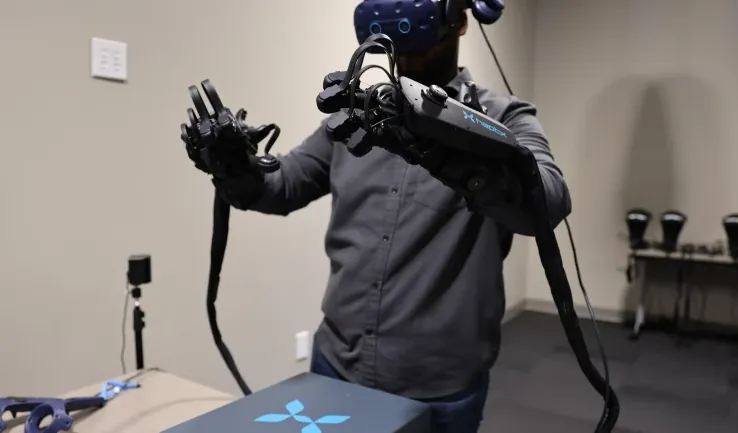
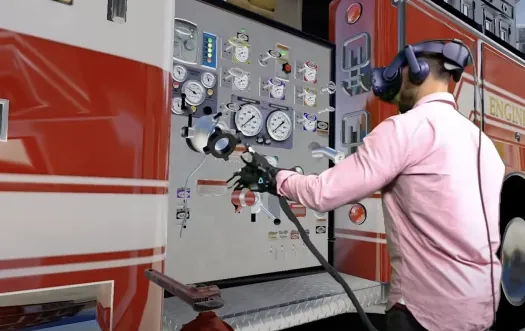
A firefighter trainee in a VR headset and HaptX Gloves operates a virtual pump panel.

Why touch belongs in training

People learn manual skills by doing them.

In jobs where dexterity and tool-handling mean the difference between success and failure, simulation has to engage the hands. With HaptX Gloves G1, learners use their hands naturally — gripping, turning, pressing — to build procedural and muscle memory, combining the realism of live training with the scalability of virtual training.

Up to 4×

faster training in VR-based courses than in traditional classroom learning, according to a 2022 PwC study cited by HaptX.

“Touch leaves a memory trace that persists long after the physical sensation is gone.”

Scientific American (opens in a new tab)

What a haptic training session adds

  1. 01

    See it

    The trainee enters a simulation of the real workplace — a locomotive engine bay, a glovebox, a fire-engine pump panel.

  2. 02

    Feel it

    As they grip valves, tools and controls, actuators press the skin and exotendons resist the fingers where the virtual objects are.

  3. 03

    Use it

    They repeat the procedure as often as needed — while instructors change conditions in real time, safely and without consuming resources.

Training case studies

Where teams are training with touch.

From rail maintenance to nuclear-materials handling and surgery — each labeled with its current status.

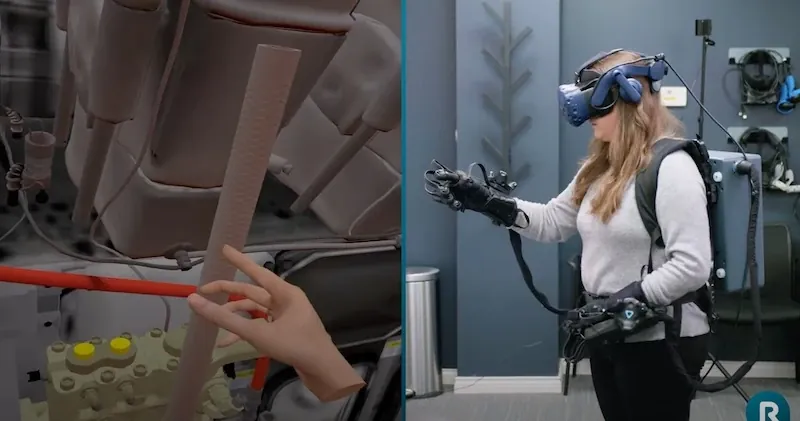
A trainee in HaptX Gloves and a VR headset works through a Roundtable Learning locomotive module.

Mechanics troubleshoot Tier 4 locomotive engines in VR — with touch.

Roundtable Learning’s Mechanical GEVO Tier IV course gives BNSF mechanics immersive, step-by-step simulations to troubleshoot and repair T4 engines and subsystems, with HaptX Gloves G1 delivering haptic feedback for a multi-sensory learning experience aimed at improving operational safety.

It was the first VR program in BNSF’s 2024 safety and technical training initiatives, part of the railroad’s vision of a digitally enabled, injury-free workplace.
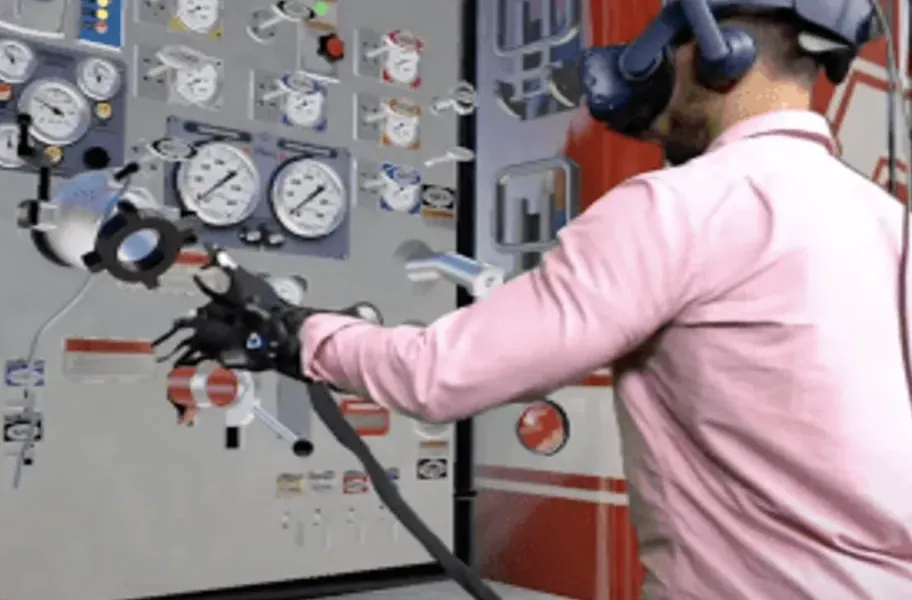
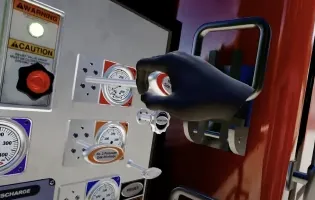
A firefighter in a VR headset and HaptX Gloves operates a fire-engine pump panel simulator. Inside the simulation: a virtual gloved hand on a pump-panel control.

Pump operation training — without wasting a drop of water.

Live pump-panel training can consume tens of thousands of gallons of water and ties up people and equipment, so firefighters may not train as often as needed. HaptX built a self-directed tutorial in which trainees adjust knobs, push buttons and turn handles on a virtual fire engine as they would in the real world, feeling them as they grip.

Instructors can change operating conditions in real time — drop hydrant pressure or rupture a hose at the press of a button.

Y-12 National Security Complex: A multi-user virtual glovebox for hazardous-material handling.

A multi-user virtual glovebox for hazardous-material handling.

Using the HaptX SDK, the team built multi-user haptics into a virtual glovebox simulator in Unreal Engine, now being studied against joystick and physical-glovebox conditions.

Prototype under evaluationRead the case study
ECS, Mayo Clinic & Defense Health Agency: Haptics-based medical training inside the U.S. Army’s Synthetic Training Environment.

Haptics-based medical training inside the U.S. Army’s Synthetic Training Environment.

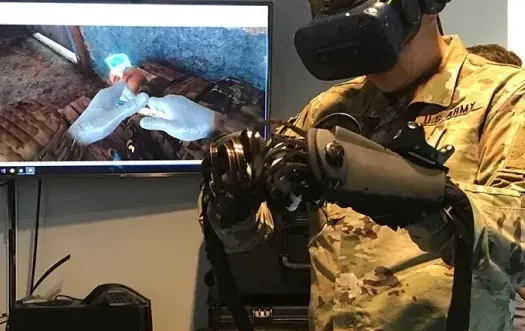
ECS uses HaptX Gloves to simulate live patient tissue in VR and to run collaborative, multiplayer training scenarios.

Research collaborationRead the ECS release (opens in a new tab)
FundamentalVR: Orthopedic surgery simulation using the whole hand.

Orthopedic surgery simulation using the whole hand.

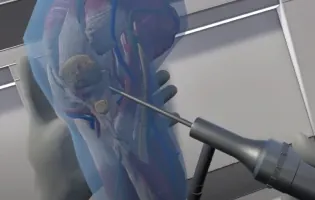
HaptX Gloves were integrated into FundamentalVR’s Surgical Haptics Intelligence Engine and first demonstrated at the AAOS annual meeting.

Proof of conceptExplore training

Benefits

Level up your workforce with industrial-grade haptics.

  • A trainee reaches into a virtual glovebox wearing HaptX Gloves.

    Reduces negative training

    Workers move their hands as they would in the real world, rather than learning controller habits that don’t transfer.

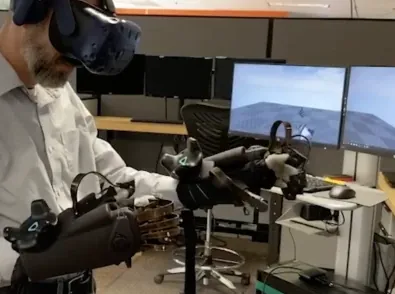
  • A user in a VR headset and HaptX Gloves at a simulation workstation.

    Encourages repeat practice

    Adding realistic touch to vision and sound engages learners in repeat simulation sessions.

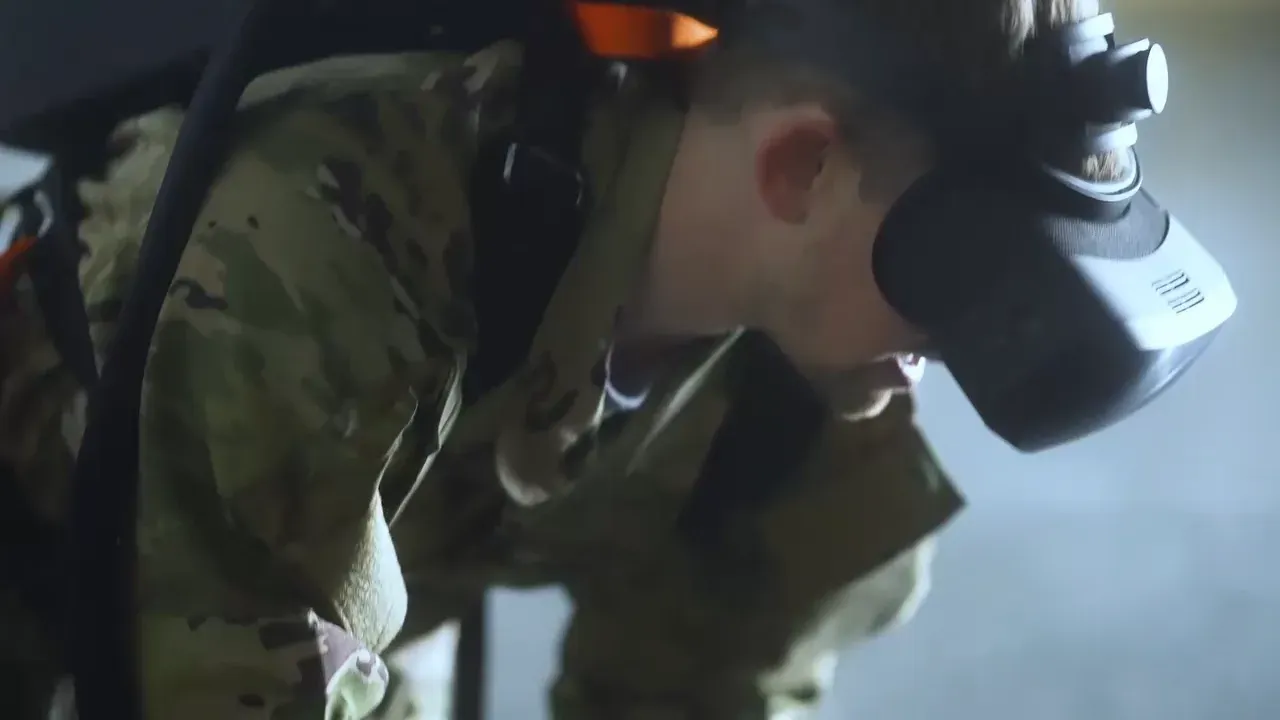
  • A trainee in uniform uses HaptX Gloves in a medical VR simulation.

    Improves safety

    Rehearse high-consequence scenarios without the injury risks of live training.

Start a conversation

Let’s discuss your training program.

Tell us about the procedure you need to teach. We can give you a clearer picture of the configuration, development path and ROI considerations for your organization.